How it works
From an area to a letter on the owner's desk.
- Search an area. A street, a postcode, a town or a boundary you draw on the map, filtered by property type, rateable value, owner type, EPC band or signs of trouble.
- Run the vacancy check. See which units have left the council's rates list, are listed as empty, are billed to the freeholder or changed ratepayer, with the freehold owner of each.
- Keep and work your prospects. Add buildings and companies to a list with a status and notes, export it for your CRM, and write to the owners at their registered office.
Search results that tell you where to look
Spot the buildings with a story
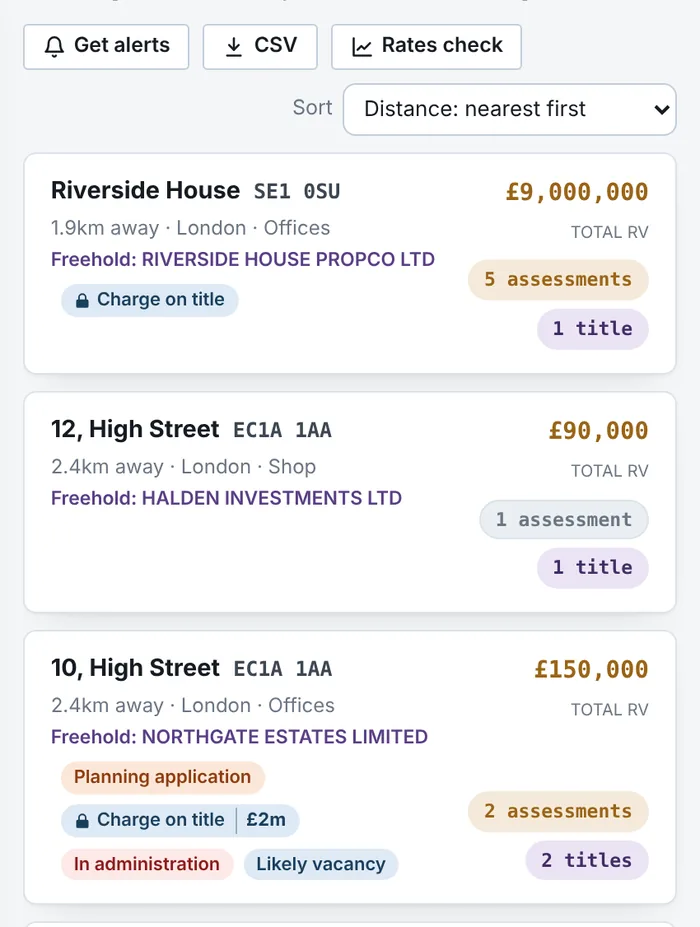
Search an area, a street or a drawn boundary and see at a glance which buildings have something going on: owners in administration, charges on the title, planning applications and units that look empty.
- Filters for distress, likely vacancy, owner type, EPC band and size
- Run the vacancy check to list the units that look empty or just changed ratepayer
- Keep prospects in lists with a status and notes, and export them to your CRM
- Save the search and get new matches and changes every Monday
- Download the results as a spreadsheet
Vacancies, prospect lists and letters to owners
Find commercial property that is empty or about to change hands, keep your prospects in one list with a status and notes for each, and send owners a letter at their registered office. Everything comes from public records: the councils' business-rates lists, HM Land Registry and Companies House.
Find empty commercial units in any search
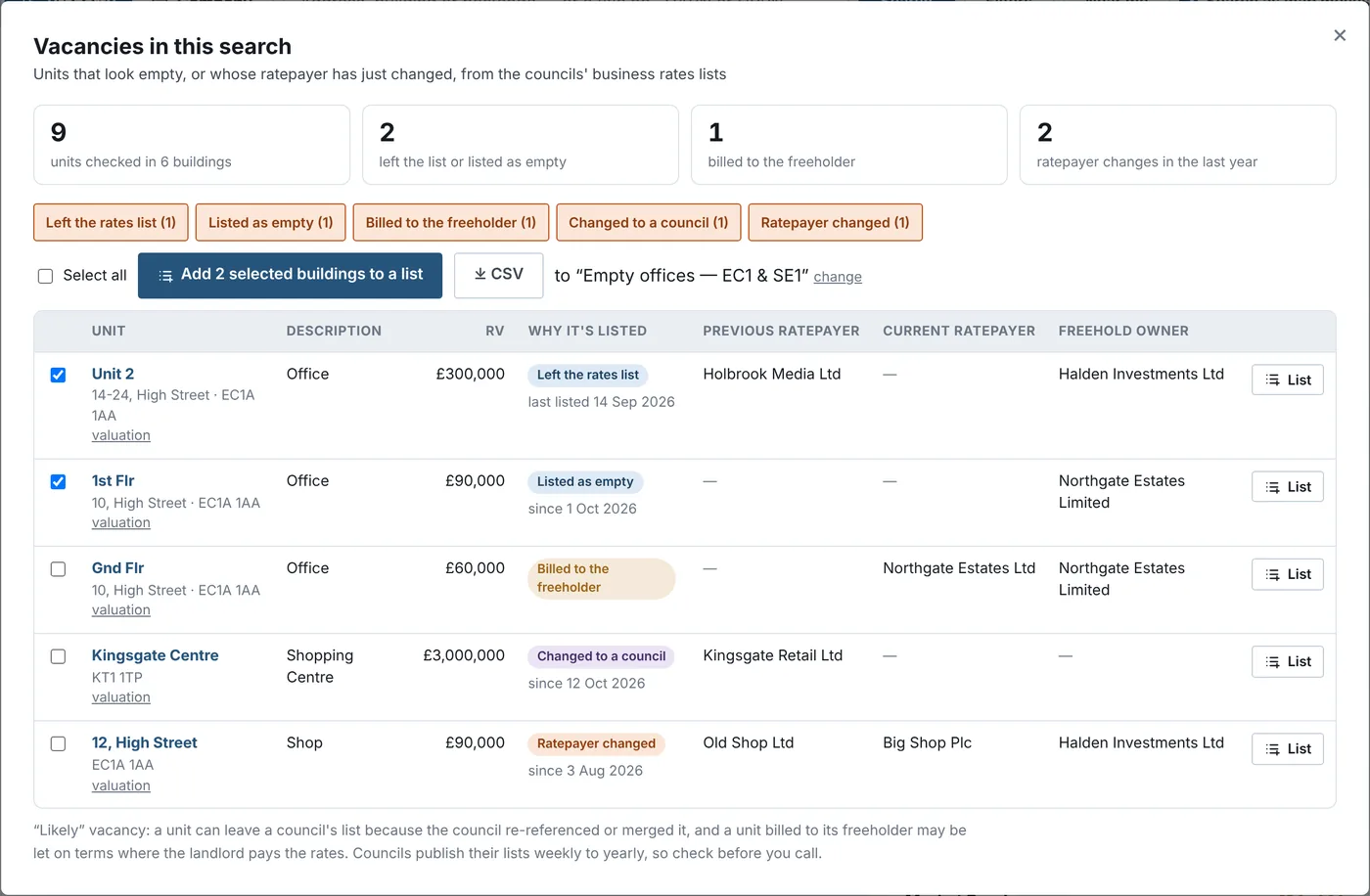
Run a property search for a street, postcode, town or an area you draw, then press Vacancies. Every rated unit in those buildings is checked against the councils' business-rates lists and recent changes of ratepayer, so you see which offices, shops and industrial units look empty before they are marketed.
- Left the rates list: the unit has dropped off the council's latest business-rates list
- Listed as empty: the council marks the unit empty or exempt from rates
- Billed to the freeholder: the landlord is paying the rates, as it must on an empty unit
- Changed ratepayer: a new business, or the council, has taken over the rates in the last year
- The previous and current ratepayer, the rateable value and the freehold owner for each unit, as a spreadsheet if you want it
Prospect lists with a status and notes, ready for your CRM
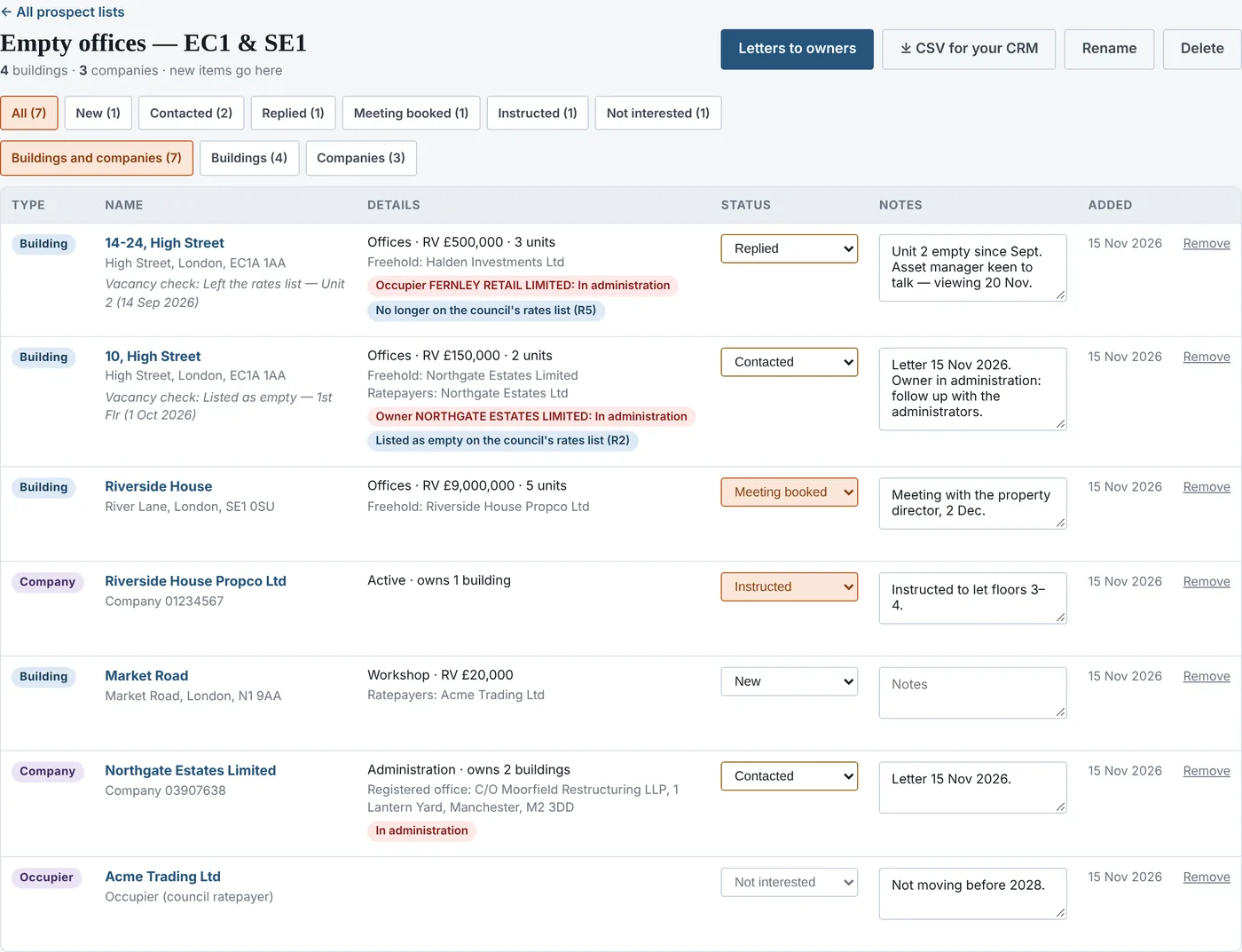
Add buildings and companies to a list from the vacancy check, a building record or the company search. Each one keeps its status, from new and contacted through to meeting booked and instructed, and your own notes, next to what the public record says about it.
- Buildings and companies in the same list, with the freeholder, ratepayers, rateable value and any insolvency or vacancy signals
- Filter by status to see who to chase next
- Download a list as a spreadsheet with status, notes, addresses, Companies House status and registered office, in columns most CRMs import
Write to the owners: off-market letters to registered offices
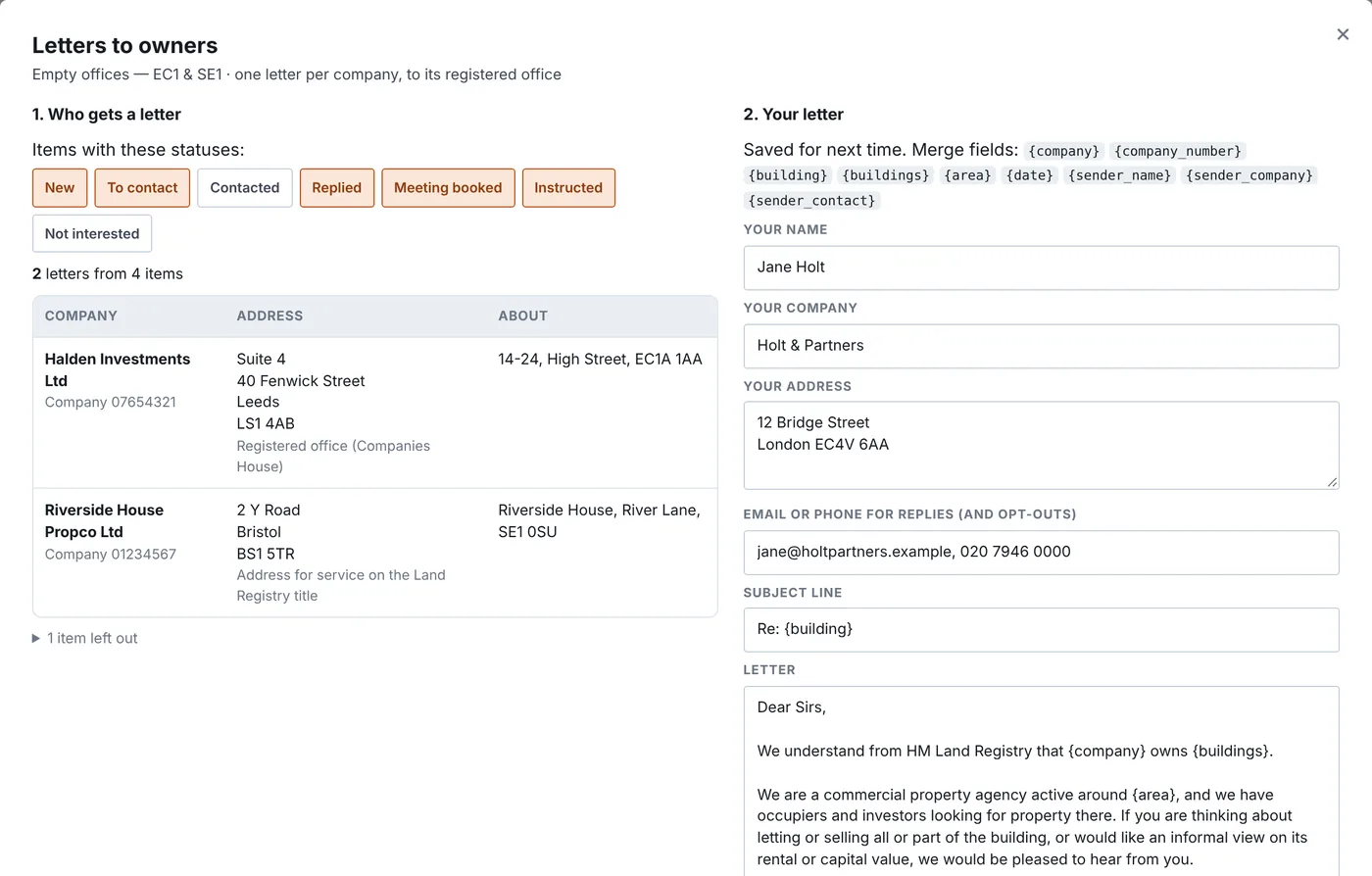
Turn a list into letters. For every building, the freehold owner is found on its Land Registry title, and its Companies House registered office becomes the address. Write your letter once with merge fields; download print-ready PDF letters, one per company, or a mail-merge file.
- One letter per company, naming each of its buildings on your list
- Owners in administration are flagged, as the post will go to the insolvency practitioner
- A4 letters laid out for a window envelope, with an opt-out line you can edit
- Companies only: individuals, dissolved companies and overseas owners without a UK company number are left out
- Mark the letters as sent, and the list records the date
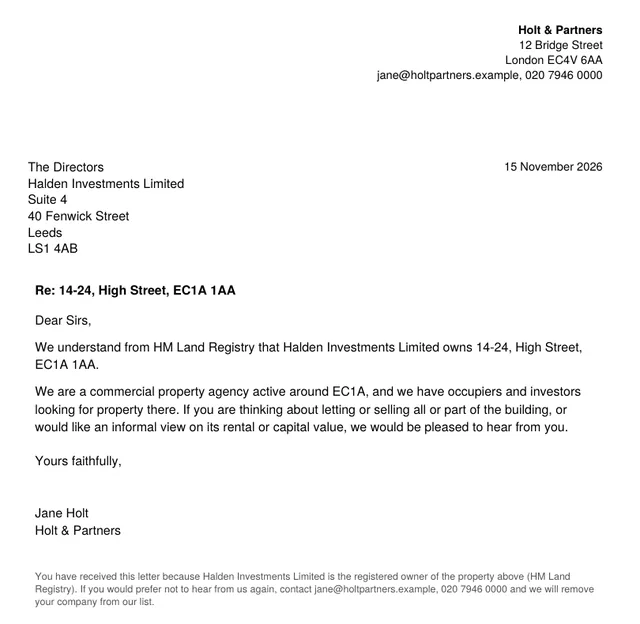
The vacancy check, prospect lists and letters come with a free account. Vacancy signals are available where the council publishes who pays the rates.
Signals on every search
Every building is checked against Companies House and the councils' business-rates lists, so you can see at a glance where an owner or occupier is struggling, or a unit looks empty.
Owner or occupier insolvent
The company that owns or occupies the building is in administration, liquidation, receivership or a company voluntary arrangement.
Registered to a dissolved company
The property is still registered to a company that has been dissolved or closed, which often means it has passed to the Crown.
An early warning
The owner or occupier is late with its accounts or confirmation statement, or faces a proposal to be struck off the register.
Units that look empty
A unit has dropped off the council's business-rates list, or the council lists it as empty.
Filter any search by these signals, save it, and new ones arrive in your Monday email. Occupier signals are available where the council publishes who pays the rates.
Questions agents ask
What does it cost?
Search is free with no account. The vacancy check, prospect lists and letters to owners come with a free account: up to 30 lists of 500 buildings and companies each.
How can I find empty commercial property in an area?
Search for the area by street, postcode, town or a boundary you draw, then run the vacancy check. It lists the units that have dropped off the council's business-rates list, that the council lists as empty, whose rates are billed to the freeholder (landlords pay rates on empty units), or whose ratepayer changed in the last year, with the previous and current ratepayer and the freehold owner. These are signs, not proof: a unit can leave a list because the council re-referenced it, so check before you act.
Can I write to the owner of a commercial building?
Yes. Add buildings to a prospect list and use Letters to owners: the freehold owner comes from the HM Land Registry title and the address from its Companies House registered office, or the address for service on the title. You get print-ready PDF letters or a mail-merge spreadsheet. Only companies are included, never individuals, and the default letter carries an opt-out line.
Who is left out of the letters?
Individuals, companies that have been dissolved, and owners without a UK company number, such as overseas companies and councils. Owners in administration or liquidation are included with a warning, because the post will go to the insolvency practitioner.
Why don't vacancy signals cover every council?
They come from each council's published business-rates list, so they are available where the council publishes who pays the rates. More councils are added as their data is checked and matched.
Find the next instruction
Search an area, run the vacancy check and start a list. It's free.
Search an area →Not an agent? See the tools for lenders, owners, surveyors, due diligence and planning.