How it works
Three steps, using the list you already keep.
- Upload your loan book. A spreadsheet (CSV) or pasted rows, up to 1,000 securities per portfolio, each with your own loan reference. Rows are matched to a building by title number, UARN, UPRN or address and postcode, and to the borrower by company number or name. Add your lender name, and your own charges are told apart from everyone else's.
- Confirm the few we're unsure of. Anything without a confident match waits for you, with a short list of likely buildings to pick from. Nothing is guessed silently.
- Get the Monday email. Each week, the changes that touch a security or a borrower, listed under your loan references, with a link to the full record.
What we watch for you
Every security and borrower is checked against the public registers each week.
Another lender's charge
New charges registered at Companies House that name your security's title or address, with the lender, status and the stated amount where the charge gives one. Another lender's charge is flagged apart from your own, so a second charge you didn't know about stands out.
Borrowers in trouble
Administration, liquidation, receivership, strike-off and overdue accounts or confirmation statements at Companies House, for each borrower and for the registered owner of each security.
Occupiers leaving or struggling
Changes on the council's business-rates list for each unit: a new occupier, one that's left, a unit shown as empty, and occupiers that are themselves in insolvency, where the council publishes its list.
Sales and ownership changes
A different registered proprietor on a freehold title linked to the security, from HM Land Registry's monthly company ownership data.
EPCs below the letting minimum
Units rated F or G, below the E minimum for letting non-domestic property, and certificates that have expired or are about to. The Monday email warns you 60 days before a certificate expires.
Planning at or near the security
New planning applications matched to the building, and decisions on them, from local planning authorities' records.
What the portfolio page shows
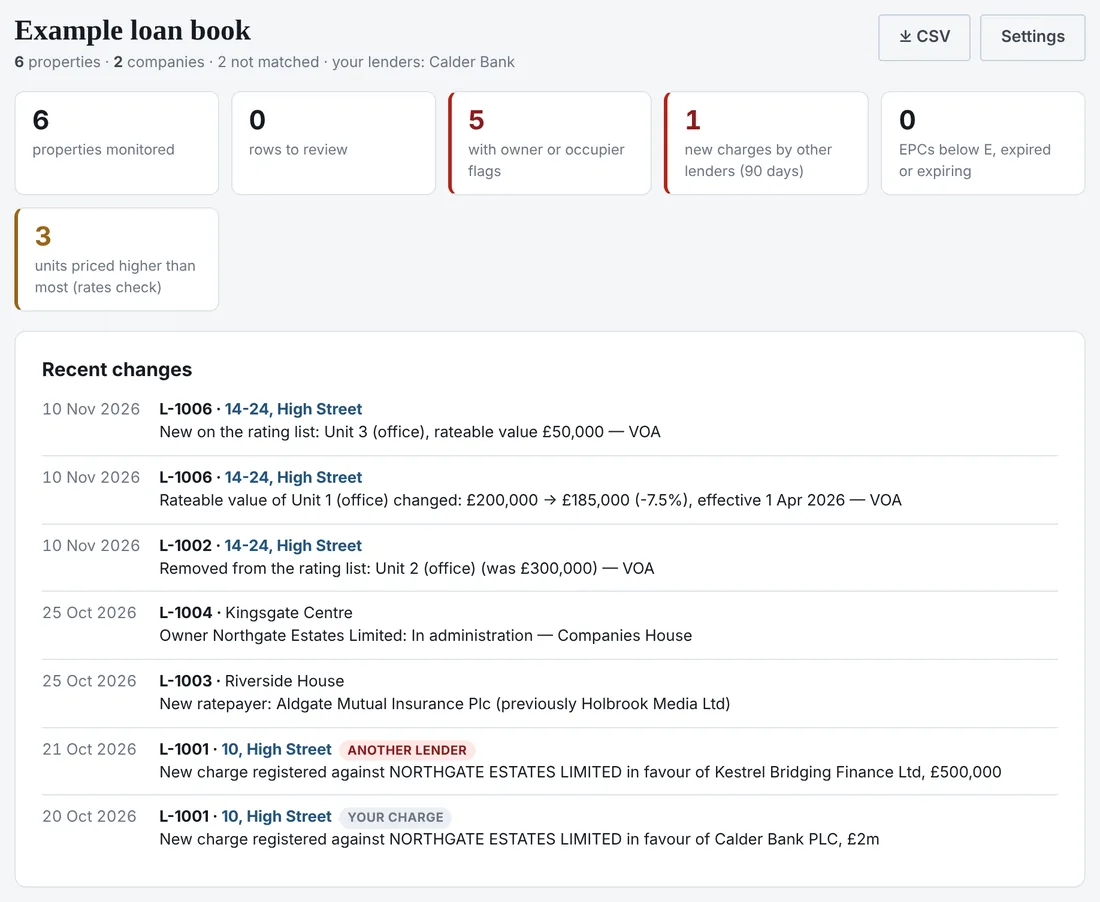
Every security on one page, under your references
Owner, current occupiers, charges on the title, EPC band and expiry, and any owner or occupier in trouble at Companies House. See at a glance which loans need a look, and download the lot as a spreadsheet.
- Tiles for securities monitored, flags, new charges by other lenders
- Recent changes listed newest first, each against its loan reference
- A due-diligence pack (PDF) for any security, from its row
A due-diligence pack for each security
One PDF per title or building for the credit file, built from the same data as the site, with a summary of points to check on page one.
- Registered proprietor, its group, Companies House status and country of incorporation
- Charges naming the title: lenders, status, dates and stated amounts
- Company owners of the title since 2017
- Rating assessments and current occupiers, with their EPC bands
- Energy certificates, with units below the MEES minimum flagged
- Planning applications, and anything still undecided
- Signals and every change recorded in the last 12 months
The pack is a summary of public data, not an official copy of the register, a local search or a report on title. Charges shown are Companies House filings that name the title, not HM Land Registry's charges register.
Questions lenders ask
What does it cost?
Portfolios, the Monday email and due-diligence packs are free with a verified account: up to 10 portfolios of 1,000 securities each, and 25 packs a day.
Which charges can you see?
Charges registered at Companies House against the companies that own each title, shown on a title only when the charge's own wording refers to that property, by title number, address or postcode. How each one was matched is labelled. They are not HM Land Registry's charges register, so a charge created before companies had to register them, or one that doesn't name the property, won't appear.
Does it cover properties owned by individuals?
Ownership comes from HM Land Registry's data on titles held by UK and overseas companies. Titles held by private individuals aren't published in that data, so for those you'll see the building, its rating, occupiers, energy certificates and planning, but no owner.
How is my loan book kept private?
Your portfolios are visible only to your account. They aren't shared, published or used to change what other users see. You can delete a portfolio at any time.
Which areas are covered?
England and Wales: every property on the VOA's non-domestic rating list, and every company-owned title in HM Land Registry's data. Occupier details depend on each council publishing its business-rates list.
Put your loan book on watch
Upload the list you already keep. It takes a few minutes, and it's free.
Start a portfolio →Not a lender? See the tools for owners, agents, surveyors, due diligence and planning.